
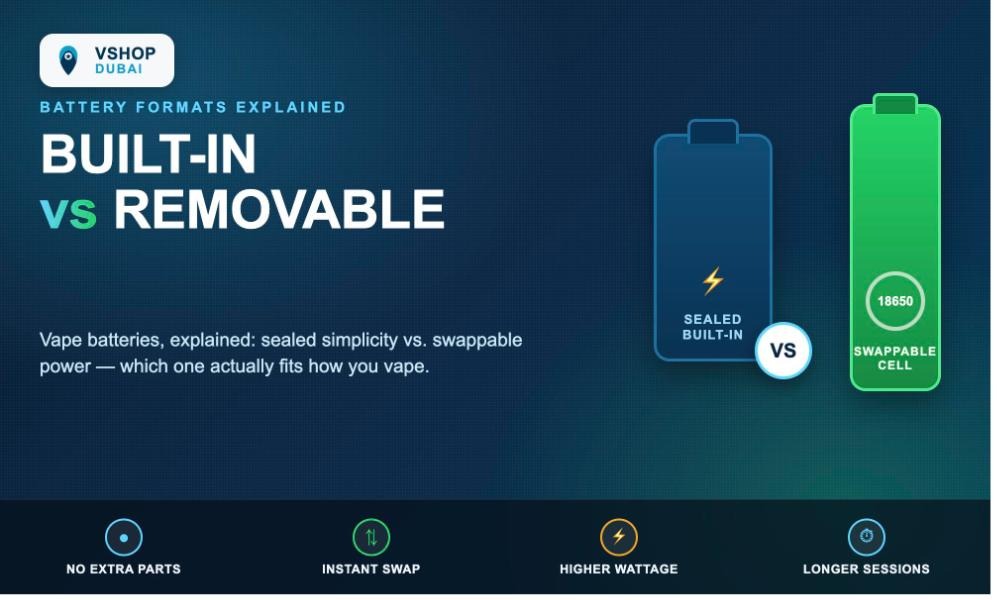
Quick Answer: Built-in batteries are sealed into the device — smaller, simpler, and needing no separate purchase, but fixed in capacity and replaced only by replacing the whole device. Removable 18650/21700 cells cost extra and take longer to charge, but you can swap in a charged spare instantly, replace a worn cell cheaply, and reach higher wattage output. Neither is “better” outright — it depends on whether you value simplicity or flexibility more.
Table of Contents
- Built-In Batteries: Pros and Cons
- Removable Batteries: Pros and Cons
- 18650 vs. 21700: What’s the Difference
- Real Examples: Built-In vs. Removable Devices
- Which Should You Choose?
- FAQs
Every vape’s battery falls into one of two categories: sealed inside the device with no user access, or a swappable cylindrical cell you can pull out and replace. This one design choice shapes almost everything else about how a device is used day to day — how you charge it, what happens when the battery eventually wears out, and how much power it can put out.
Built-In Batteries: Pros and Cons
Pros: no separate battery purchase or charger needed, the whole device stays smaller and lighter since there’s no cell compartment to fit, charging is simple (plug in via USB-C, no removing anything), and there’s no battery contact or wrapping to maintain.
Cons: capacity is fixed at whatever the manufacturer built in, which caps the maximum output the device can push; when the battery eventually degrades, the entire device needs replacing rather than just a cell; and if the battery itself develops a fault, there’s no way to swap it out.
Removable Batteries: Pros and Cons
Pros: higher output ceilings, since 18650/21700 cells can supply more current than a compact built-in pack; you can carry a charged spare and swap it in instantly with zero downtime; and if a cell wears out, you replace just the battery, not the whole device.
Cons: cells and a dedicated charger are sold separately, they generally take longer to charge given their higher capacity, and using them safely means understanding basic battery handling — see our vape battery charging safety guide for the real do’s and don’ts.
18650 vs. 21700: What’s the Difference
The numbers refer to physical cell dimensions (18mm x 65mm vs. 21mm x 70mm), and the size difference translates directly into capacity: most 18650 cells run roughly 2,500-3,500mAh, while most 21700 cells run higher, roughly 4,000-5,000mAh. The 21700 format holds meaningfully more charge and generally supports higher sustained wattage, at the cost of a bulkier device; the 18650 stays more compact and is the more widely compatible standard across older and newer mods alike.
Real Examples: Built-In vs. Removable Devices
On the built-in side, the OXVA Xlim Pro runs a sealed 1,000mAh cell in a compact MTL pod kit, and the Tugboat Evo Purple Rain takes it further — its 850mAh built-in battery is entirely non-rechargeable, since it’s a single-use disposable. On the removable side, both the Vaporesso Target 100W Starter Kit and the Lost Vape Thelema Solo 100W run on a single user-supplied 18650 or 21700 cell, while the Voopoo Drag X2 is a third real removable-battery option on a single 18650, reaching a 5-80W range on its GENE.TT chipset. Worth noting: not every high-wattage box mod uses a removable cell — the Vaporesso Armour Ultra 100W Kit is a sealed-battery box mod, packing a built-in 5,500mAh cell instead, proving built-in batteries aren’t limited to small, low-power devices either.
Shop Both Battery Types
Whether you want the simplicity of a sealed battery or the flexibility of a removable cell, both are in stock.
Which Should You Choose?
If you want the simplest possible experience — charge it, vape it, no extra parts to buy or manage — a built-in battery device is the easier choice, especially for MTL pod kits where the lower power ceiling isn’t a limitation anyway. If you vape heavily throughout the day, want to run higher wattage, or just don’t want to be stuck waiting on a charge cycle, a removable-battery device lets you keep a spare cell charged and ready, at the cost of a small extra upfront purchase and a bit more to keep track of.
FAQs
Can I replace a built-in battery myself when it wears out?
Generally no — built-in batteries are sealed in during manufacturing, so a worn-out cell usually means replacing the whole device rather than just the battery.
Is a 21700 battery always better than an 18650?
Not necessarily — a 21700 holds more charge and supports higher wattage, but it’s physically larger and heavier, and not every device is built to fit one. An 18650 is the more broadly compatible, more compact option.
Do removable batteries need a separate charger?
Many devices charge the cell in place via USB-C, but a dedicated external charger is safer for daily use and lets you charge a spare while the device is still in use.
Why do disposables use built-in, non-rechargeable batteries?
Disposables are designed for a single lifespan matched to their e-liquid capacity, so a sealed, non-rechargeable cell keeps the device simple and cheap to manufacture rather than adding charging circuitry it will only ever use once.
Is it safe to carry a spare 18650/21700 battery loose in a pocket or bag?
No — loose cells can short if they contact metal objects like keys or coins. Use a battery case, and see our battery charging safety guide for the full do’s and don’ts.
Does a removable battery device charge faster than a built-in one?
Usually the opposite — removable 18650/21700 cells generally hold more capacity than a built-in pack, so despite similar charging currents, a full charge typically takes longer.
See how battery format connects to output and control in our temperature control mode guide, or browse the full vape devices collection and portable pod system kit range at VShop Dubai.