
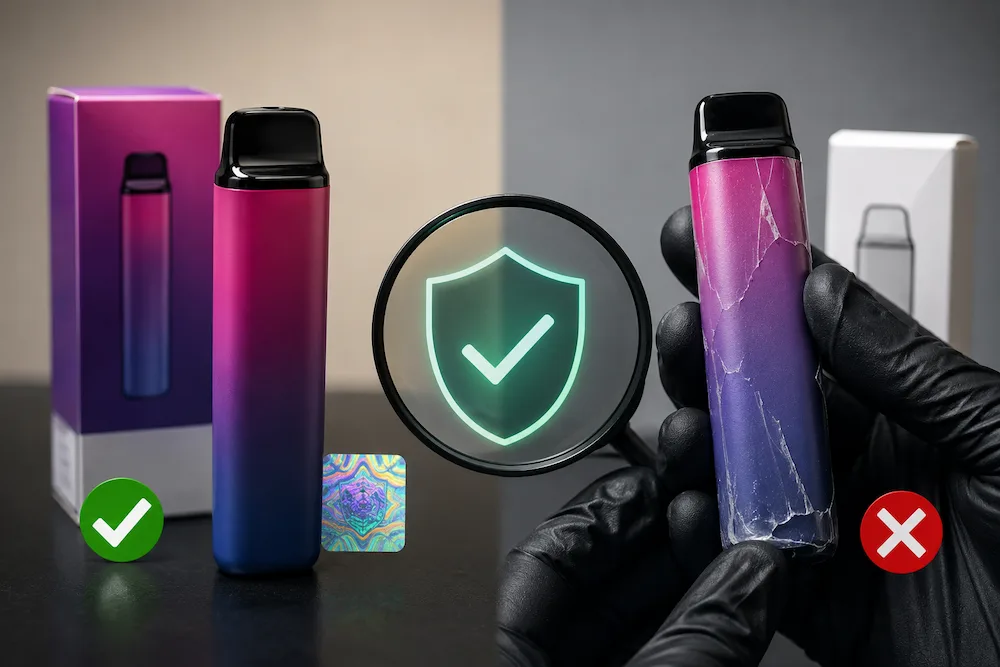
The short answer
A vape sold legally in the UAE has to meet a specific national standard. That gives you three checks that need no special equipment:
- The health warning appears in both Arabic and English, with the wording the standard prescribes.
- A disposable’s e-liquid capacity is 10 ml or under — 50 ml for a refill bottle.
- The manufacturer’s verification code checks out on the brand’s own site, and returns as a first-time check.
If a device fails these checks, it is either counterfeit or a grey import that was never approved for sale here. Either way it sits outside the system that is supposed to test it.
Why the UAE gives you a better test than most markets
Most guidance on counterfeit vapes comes from the UK or the US and stops at general advice: look at the printing, scan the code, don’t trust cheap prices. That advice is fine as far as it goes, but it asks you to judge a fake by how it looks.
The UAE offers something more useful, because the market here runs on a written technical standard. Vaping products became legal to sell in April 2019 under UAE.S 5030:2018, and that standard sets hard numbers. Oversight originally sat with ESMA and moved to the Ministry of Industry and Advanced Technology (MoIAT) in 2020, which now handles product certification through the Emirates Conformity Assessment Scheme.
The practical consequence: a legally imported product has to comply with published limits. So instead of guessing whether printing looks slightly off, you can read the box and check it against a number. A counterfeiter copying a device built for another market usually copies that market’s labelling too — which is exactly what gives it away here.
Check 1 — The bilingual warning, word for word
The standard requires nicotine products to carry a health warning in Arabic and English. The prescribed English wording is:
Contains nicotine which causes severe addiction, increased heart rate and high blood pressure. Nicotine is harmful to the health of pregnant and nursing women, and people suffering from chronic pulmonary diseases such as asthma and pulmonary embolism.
And separately:
It is prohibited to sell and consume this product by individuals under the age of 18, and it is not recommended for non-smokers.
Read those against your own packaging. Three failure patterns come up repeatedly:
- English only, no Arabic. Straightforward fail.
- A warning from another jurisdiction. A California Proposition 65 notice, an FDA notice, or UK/EU TPD wording tells you the pack was printed for a different regulator.
- Approximately-right Arabic. Counterfeiters copy Arabic text as an image and it degrades — clipped letters, wrong ligatures, text that doesn’t align with the English block beside it.
The age line is worth noting for a second reason. The legal threshold in the UAE is 18, under Federal Law No. 15 of 2009. If a pack or a seller states 21, that number came from somewhere else.
Check 2 — Capacity
The standard limits an integrated tank to 10 ml, and a refill bottle to 50 ml.
This one catches a specific category of fake: the very high puff-count disposable vape. Puff counts themselves are marketing figures and are not regulated, so a “40,000 puff” claim is not in itself evidence of anything. But if the box also states a 20 ml or 25 ml e-liquid capacity, that figure is outside the UAE limit and the unit was not approved for this market.
Where a puff count and a capacity figure can’t both be true, treat the capacity number as the one that matters, because it is the one the regulation measures.
Check 3 — The verification code
Most established brands print an authentication code — a scratch panel, a QR code, or a serial number — that resolves to a checker on their own site. This applies to vape pods as much as to whole devices, since pods are counterfeited just as often.
Two things people get wrong here.
A QR code proves nothing by itself. Counterfeiters print QR codes too. Some resolve to a convincing page that always returns “authentic.” What matters is that the code resolves to a domain that is unmistakably the manufacturer’s own, reached by typing the brand’s official address yourself rather than by following the code blindly.
A genuine code should verify as a first check. Most brand systems record how many times a code has been queried. If the response says the code has already been checked several times, the likely explanation is that the code was copied from a real pack onto a batch of fakes.
If the brand publishes no verification method at all, you fall back on Checks 1 to 3 and on the channel you bought from. Coverage varies by manufacturer — Elf Bar and Al Fakher are among the brands that operate their own checks.
Verification links by brand — to be added. We are confirming the official verification address for each brand we stock before publishing them here, rather than listing links we haven’t tested.
Physical and performance signs
These are weaker signals than the label checks, because good counterfeits now clear most of them. Use them as confirmation, not as your primary test.
On the packaging: cellophane that sits loose or was clearly reheated; a batch code that is printed rather than laser-etched, or absent entirely; colour that is close but slightly off against the brand’s own product photography; a font weight that doesn’t match.
On the device: seams you can catch a fingernail in; a mouthpiece that moves under light pressure; weight noticeably lighter than the same model handled before; a charging port that sits crooked in its recess.
In use: flavour that arrives harsh from the first draw rather than developing; a burnt note within the first day; a battery that drops off long before the stated capacity would suggest. On that last point, be careful — inflated puff counts are widespread on genuine devices too, so a device that underdelivers on puffs is not on its own evidence of a fake.
Price, read properly
Deep discounting is a signal, but it is often misread.
The useful comparison is not against the cheapest listing you can find. It is against the range that licensed retailers converge on for that exact model. Retailers competing in the same market land within a fairly narrow band, because they are all buying through similar channels and paying the same excise. A listing well below that band is worth questioning.
What that does not mean is that every discount is suspect. Retailers clear slow-moving flavours and end-of-line stock at genuine reductions, and a normal promotional discount looks nothing like a price that undercuts the market by half.
Where counterfeits actually enter
Fakes concentrate in channels with no accountability: social media sellers, classified listings, informal resellers working from a phone number, and unlicensed physical outlets. The common factor is that there is nobody to return to.
The counterpart is simple. A licensed retailer has a business address, a return process, and a supply chain it can trace. If a product turns out to be wrong, that is the difference between an exchange and a loss.
If you think you already bought one
Stop using the device. If a battery has been assembled outside any testing regime, don’t keep charging it.
Keep everything — packaging, receipt, the outer box, and the code panel. Without the packaging you have no case.
Go back to the seller first. A licensed retailer should exchange or refund it. That is the fastest route and usually the only one that ends in your money back.
Report the brand’s side of it. Manufacturers run counterfeit reporting because fakes damage them directly, and a report with photographs and a batch code is useful to them.
Consumer protection. The UAE has consumer protection channels at both federal and emirate level, and Dubai’s economic department handles complaints against businesses trading in the emirate. Your practical leverage depends heavily on whether the seller was licensed to begin with.
UAE market spec at a glance
| What to check | UAE market spec | Common counterfeit or grey-import sign |
|---|---|---|
| Health warning | Arabic and English, prescribed wording | English only; Prop 65, FDA or TPD wording; degraded Arabic |
| Minimum age stated | 18 | 21 |
| Tank capacity, disposable | 10 ml or under | 20 ml, 25 ml |
| Refill bottle | 50 ml or under | Larger formats |
| Verification code | Resolves on the brand’s own domain, first check | Absent; already-used code; unfamiliar domain |
| Seller | Licensed, traceable, has a returns process | Social media, classifieds, no fixed address |
Frequently asked questions
Does a QR code mean a vape is genuine?
No. Counterfeiters print QR codes as readily as anyone else, sometimes pointing to a page built to return a positive result. The code is only meaningful if it resolves on the manufacturer’s own domain and reports as a first-time check.
Is a 50 mg or 5% nicotine label proof of a fake?
No — many devices legitimately sold through licensed UAE retailers, including 50mg/5% nicotine salt products, are stocked and sold in this market. Nicotine strength on its own isn’t a reliable way to spot a fake; use the bilingual warning wording, capacity, and verification-code checks above instead.
Do genuine vapes sold in the UAE have Arabic on the box?
Products approved for sale here are required to carry the health warning in Arabic as well as English. English-only packaging indicates the unit was labelled for a different market.
Can I tell from the flavour?
Sometimes, but not reliably, and not before you have already used it. Harshness from the first draw or a burnt note within a day or two is a reasonable indicator. Judge the label first.
Is it illegal for me to buy a counterfeit vape in the UAE?
Importing, manufacturing or selling electronic nicotine products that have not been approved is prohibited under UAE.S 5030:2018, and non-conforming goods can be seized at the border. How that applies to an individual buyer who was deceived is a different question, and it depends on the circumstances — this article is general information rather than legal advice.
Where should I buy to avoid the problem entirely?
From a licensed retailer with a verifiable address and a returns process, whose product labelling matches the checks above. It is worth knowing which brands are widely stocked in the UAE, because established names are the ones with verification systems behind them.
Sources
- UAE.S 5030:2018, Electronic Nicotine Products (Equivalents of Traditional Tobacco Products) — capacity limits, labelling requirements, prohibited descriptors. Standard text via the WHO FCTC document repository
- Ministry of Industry and Advanced Technology — mandatory UAE regulation for electronic nicotine products
- Federal Law No. 15 of 2009 on Tobacco Control — minimum age 18
- Tobacco Control Laws — UAE e-cigarette policy summary, citing UAE.S 5030 clause 4.1.11
Nicotine products are for adults aged 18 and over. This article explains how to verify a product’s compliance with UAE market requirements. It is not medical or legal advice.