Articles

Vape Firing Lock Explained: How to Stop Accidental Button Presses (2026)

Quick Answer: Many button-fire vapes have a firing lock — a quick multi-click sequence on the fire button that disables the firing circuit so the coil can’t accidentally activate in your pocket or bag. It’s separate from auto-cutoff/overheat protection, and it only applies to devices with an actual fire button; draw-activated devices don’t have one […]
What Is a Vape Atomizer? Coil, Wick, and Chamber Explained (2026)

Quick Answer: A vape “atomizer” isn’t one single part — it’s the coil, the wick, and the chamber working together. The coil heats, the wick feeds e-liquid to the coil, and the chamber holds the liquid and directs airflow past it. People often use “atomizer,” “coil,” and “tank” interchangeably, but they’re three distinct things that

USB-C vs Micro-USB Charging Ports banner

USB-C vs Micro-USB Charging Ports: Does It Matter? (2026)

Quick Answer: Yes, it matters. USB-C charges noticeably faster and its reversible connector is more durable over time than Micro-USB. Micro-USB isn’t dangerous or broken — it’s just the older, cheaper standard that’s gradually being phased out across the industry, vapes included. Table of Contents What’s Actually Different Between the Two Ports Why Brands Are

Pass-Through Charging Explained banner

Pass-Through Charging: Can You Vape While It’s Charging? (2026)

Quick Answer: Only if your device genuinely supports pass-through charging — and even then, doing it often isn’t great for your battery. Cheap devices without a real pass-through chip just try to charge and discharge the cell at the same time, which generates extra heat and stresses the battery. A few devices handle it properly;

Dual-coil vs single-coil vape tank comparison banner

Dual-Coil vs Single-Coil Tanks: What’s the Difference? (2026)

Quick Answer: A dual-coil build uses two heating elements instead of one, roughly doubling vapor output and e-liquid consumption while needing a lot more wattage to drive it properly. Single-coil is the lower-power, flavor-focused option. Neither is “better” — it depends on whether you’re chasing clouds or clean flavor at a lower running cost. Table

Vape safety protections banner showing a shield icon

Vape Safety Protections Explained: Short-Circuit, Overheat, and Auto-Cutoff (2026)

Quick Answer: Most quality pod kits and box mods run a small set of built-in safety protections — short-circuit, overheat, weak-battery, and an auto-cutoff timer that stops a stuck fire button. They’re standard on regulated hardware today, not a rare extra, and each one is guarding against a different failure mode. Table of Contents The

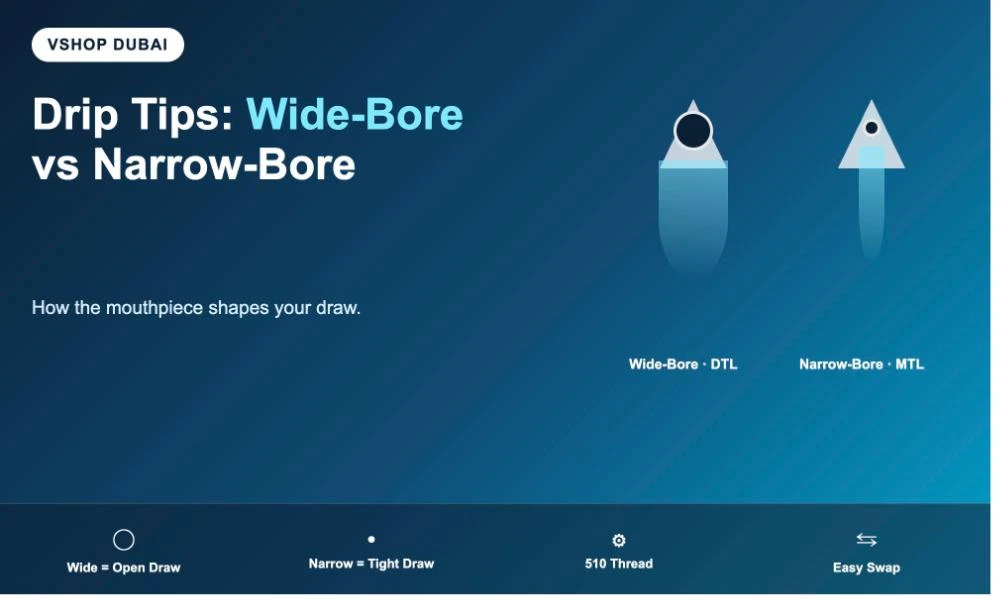
Diagram comparing a wide-bore drip tip for DTL vaping against a narrow-bore drip tip for MTL vaping

Drip Tips Explained: Wide-Bore vs Narrow-Bore (2026)

Quick Answer: A drip tip is the mouthpiece on a vape tank or RDA — the part you actually draw on. Wide-bore drip tips open the airflow up for looser, higher-vapour direct-to-lung (DTL) draws, while narrow-bore tips tighten it for a cigarette-style mouth-to-lung (MTL) pull. Most refillable sub-ohm tanks let you swap drip tips; most

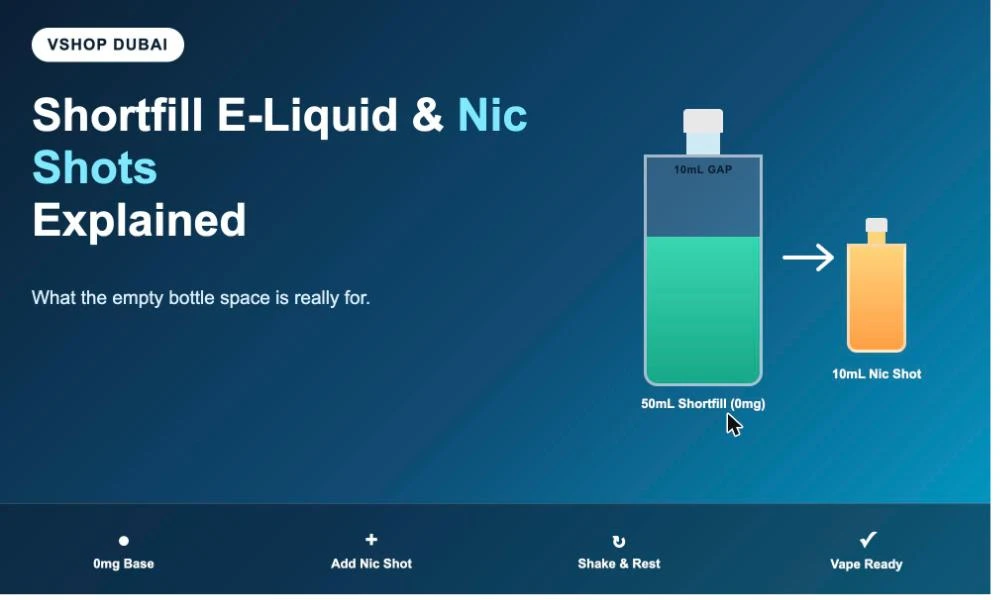
Diagram showing a shortfill e-liquid bottle with empty headroom next to a nic shot bottle, illustrating how shortfill e-liquid and nic shots work

Shortfill E-Liquid and Nic Shots Explained (2026)

Quick Answer: A shortfill is a bottle of e-liquid that isn’t filled to the top — a 50mL shortfill usually comes in a 60mL bottle, and a 100mL shortfill in a 120mL bottle. That empty space is deliberate: it’s exactly enough room to add a 10mL nic shot, a small bottle of unflavoured high-strength nicotine,

Scroll to Top